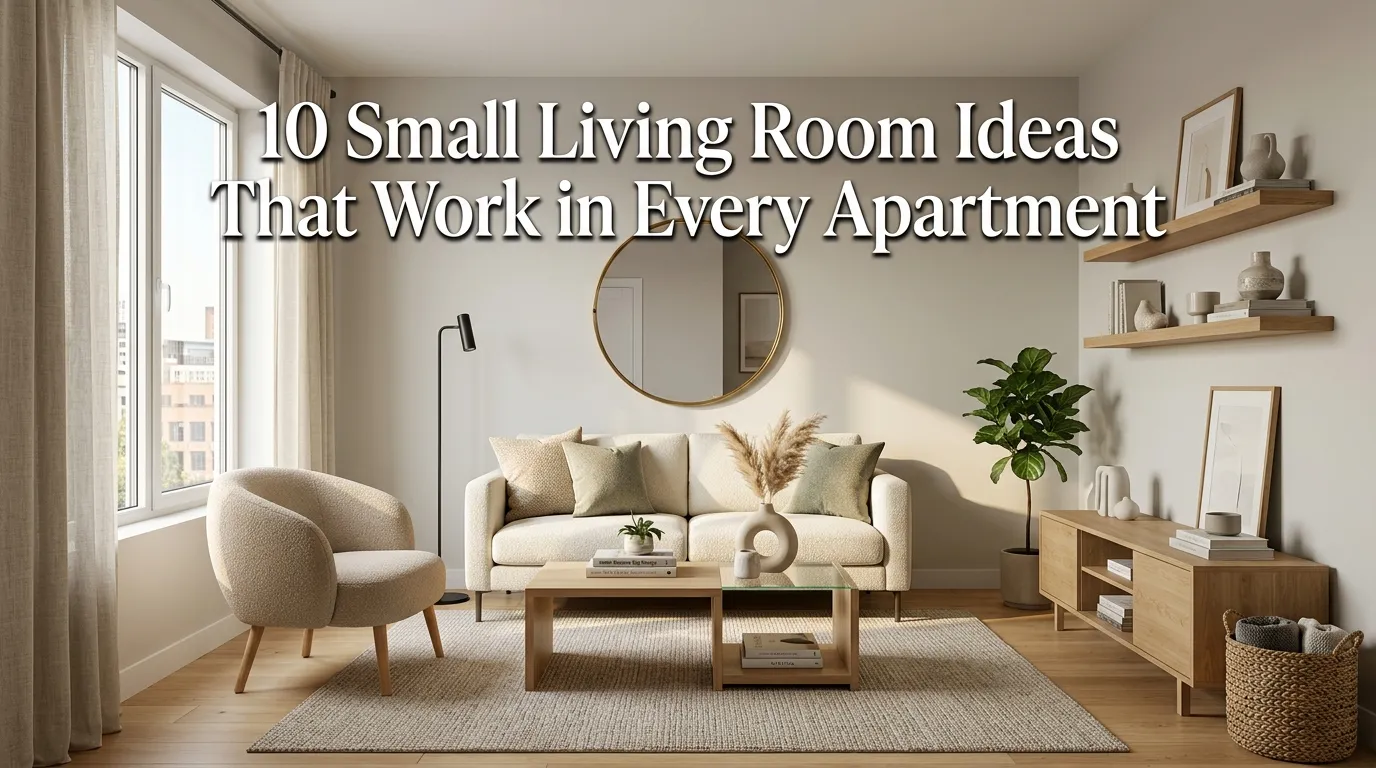
10 Small Living Room Ideas That Work in Every Apartment
A small living room can be one of the hardest spaces to decorate well. You want comfortable seating, useful storage, attractive lighting, and enough personality to make the room feel like home—but adding too many things can quickly make the space feel crowded.
The good news is that a small apartment living room doesn’t need a major renovation to feel spacious and comfortable. The right furniture proportions, thoughtful layout, light colors, and a few well-chosen decorative details can make a surprisingly big difference.
In my experience, the biggest mistake people make in compact living rooms is trying to fit everything they would use in a much larger home. Instead, the better approach is to choose pieces that work harder. An ottoman can provide seating and storage. A narrow console can fill an awkward wall without consuming valuable floor space. A wall-mounted shelf can display decor without taking up room below.
You also don’t have to sacrifice style for function. Small living rooms can look sophisticated, cozy, modern, traditional, or colorful depending on the choices you make.
These ideas are especially useful for apartment dwellers because they focus on flexible layouts, renter-friendly decorating, multifunctional furniture, and visual tricks that help a compact room feel more open.
Whether you’re furnishing your first apartment, refreshing a rental, or simply trying to make better use of a small living area, these ideas can help you create a room that feels comfortable without feeling cramped.
Table of Contents
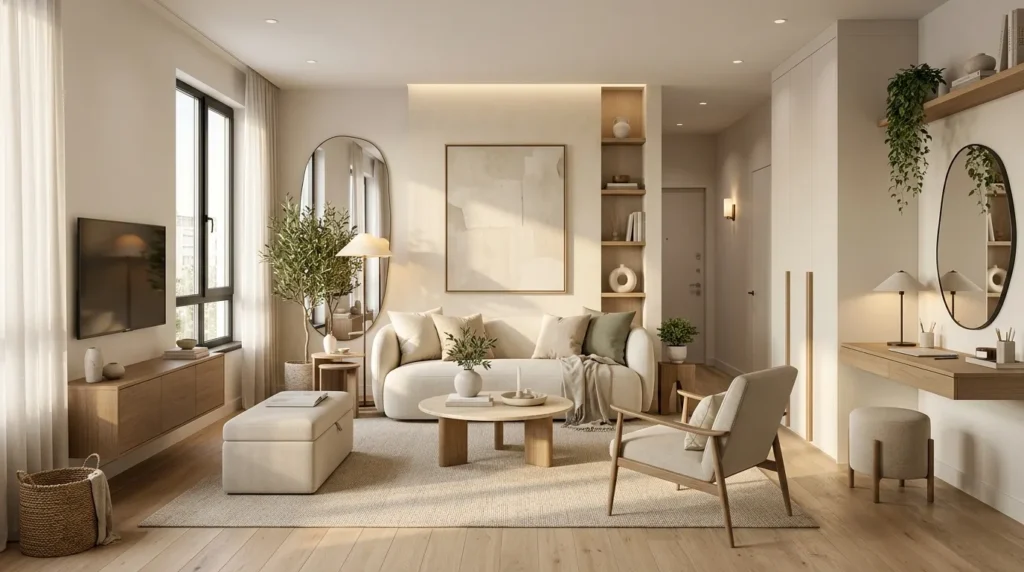
1. Apartment Scale Sofa
Choose seating that provides comfort without overwhelming the room.
2. Floating Furniture
Create visual breathing room by pulling furniture away from the walls.
3. Round Coffee Tables
Use curved furniture to improve circulation and soften tight layouts.
4. Vertical Storage
Take advantage of wall height when floor space is limited.
5. Light Neutral Palette
Use warm, bright colors to create an airy visual foundation.
6. Multifunctional Ottomans
Add flexible seating, storage, and surface space with one versatile piece.
7. Wall Mounted Lighting
Free up table and floor space with strategically placed lighting.
8. Large Area Rugs
Define the living zone without visually chopping up the room.
9. Oversized Artwork
Create a strong focal point without filling the room with accessories.
10. Hidden Storage
Keep everyday clutter contained with furniture that works behind the scenes.
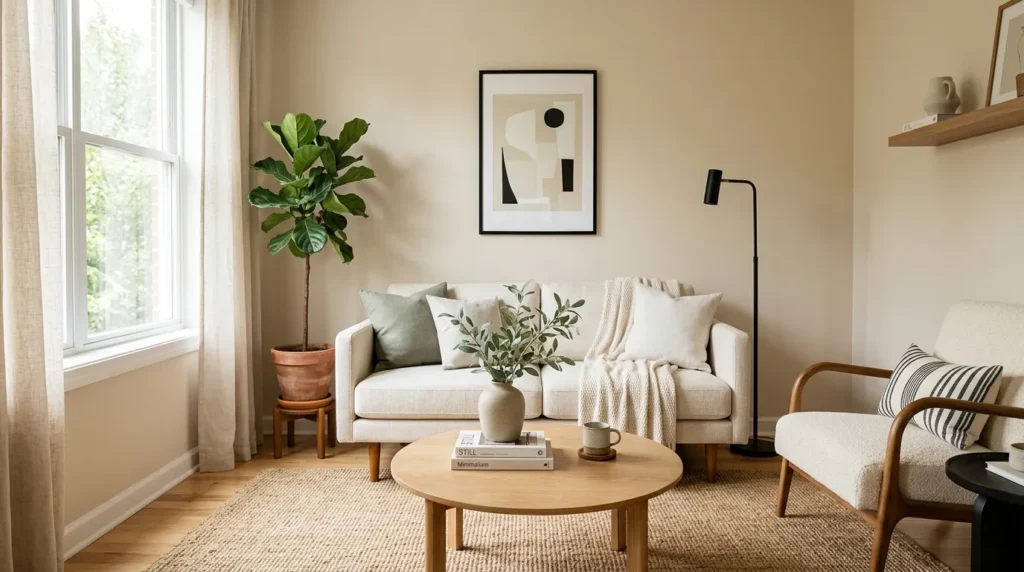
1. Apartment Scale Sofa
Quick Benefits
- Preserves walking space
- Makes the room feel balanced
- Provides comfortable seating
- Works well with compact layouts
- Leaves room for accent pieces
Why It Works
The sofa is usually the largest piece of furniture in a living room, so its proportions have an enormous effect on how spacious the room feels.
A sofa that is too deep or oversized can quickly consume valuable floor area. On the other hand, choosing a compact sofa with a streamlined silhouette can leave enough room for a coffee table, side chair, storage, and comfortable circulation.
This doesn’t mean choosing the smallest sofa available. The goal is proportion.
A moderately scaled sofa with slim arms and a reasonably shallow depth can provide plenty of comfort without visually dominating the room.
How To Style It
Look for a sofa that fits comfortably along the longest practical wall.
Apartment-friendly options include compact three-seat sofas, apartment sofas, loveseats, and streamlined sectionals.
Choose upholstery in a color that complements your walls.
Cream, beige, warm gray, soft taupe, and muted green can help create a calm foundation.
Add two or three cushions rather than covering the entire sofa with pillows.
A slim floor lamp or narrow side table can complete the arrangement without taking up much space.
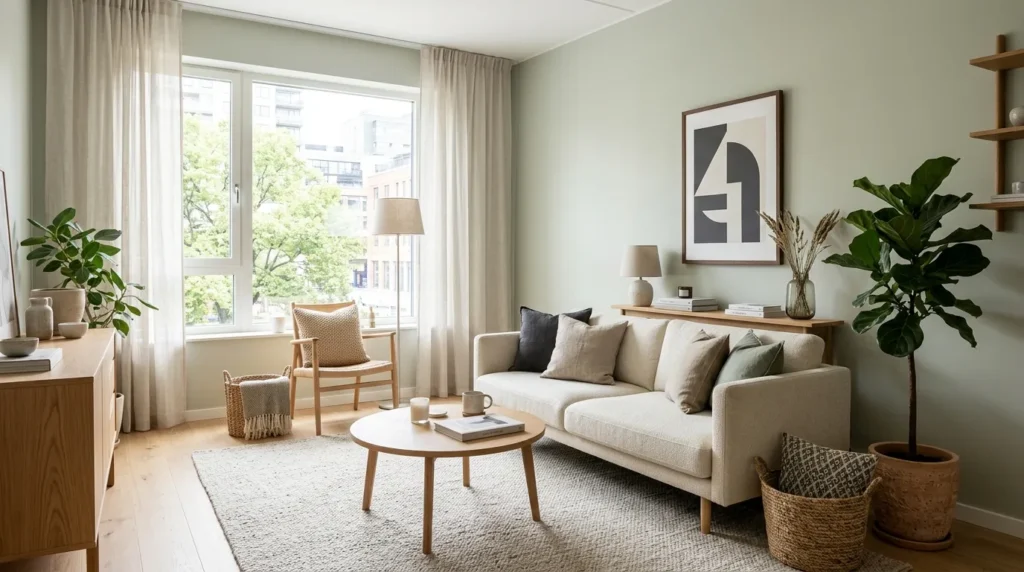
2. Floating Furniture
Quick Benefits
- Improves circulation
- Creates a more intentional layout
- Makes furniture feel lighter
- Defines the seating area
- Works in open apartments
Why It Works
Many people automatically push every piece of furniture against the walls.
Sometimes that’s necessary, but not always.
Pulling a sofa slightly away from the wall can create a more deliberate seating zone and improve the overall flow of the room.
Even a few inches can make the arrangement feel less rigid.
In an open-concept apartment, floating furniture can also help visually separate the living room from the kitchen or dining area without installing a physical divider.
How To Style It
Start by identifying the room’s natural focal point.
This might be a television, fireplace, window, artwork, or architectural feature.
Position the sofa so it relates to that focal point.
Use a rug to visually anchor the furniture.
Leave a comfortable walkway around the seating arrangement.
If space is very limited, don’t force the furniture into the center of the room.
The goal is to create breathing room while maintaining practical circulation.
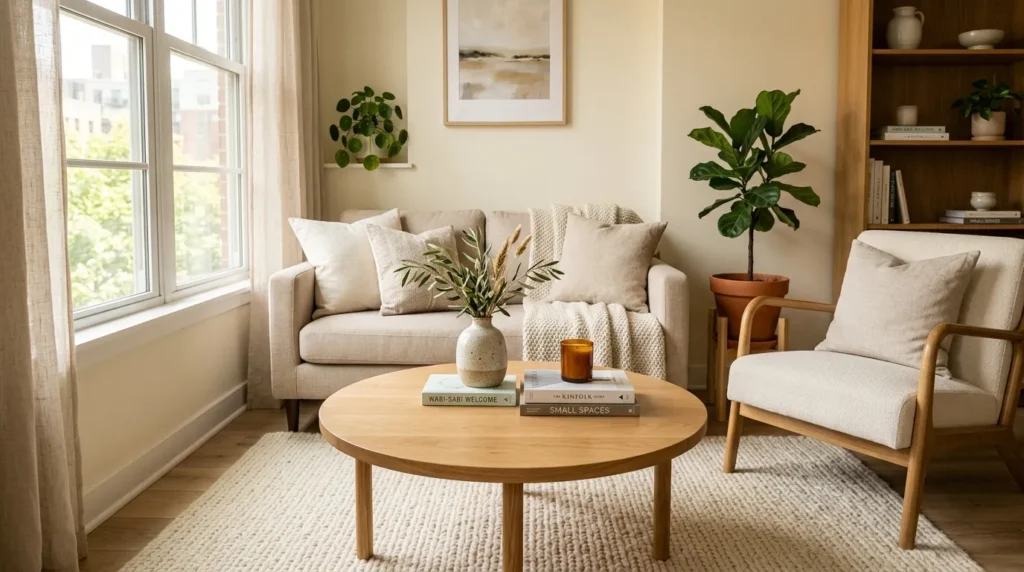
3. Round Coffee Tables
Quick Benefits
- Improves movement
- Softens rectangular furniture
- Reduces sharp visual lines
- Works well in tight layouts
- Creates a central focal point
Why It Works
A round coffee table can be surprisingly useful in a small living room.
Most sofas and apartment walls already introduce plenty of straight lines. Adding a circular table creates visual variety while making movement around the furniture easier.
There are no corners projecting into walking paths, which can be especially helpful in narrow rooms.
Round tables also work nicely with compact sofas, lounge chairs, and small sectionals.
How To Style It
Choose a table that leaves enough space between the table edge and surrounding seating.
A wooden table creates warmth.
Glass or acrylic can visually disappear into the room.
A small upholstered ottoman can provide a softer alternative.
Keep the tabletop simple.
One tray, a small vase, or a decorative book stack is often enough.
If the table includes a lower shelf, use baskets to hide small everyday items.
4. Vertical Storage
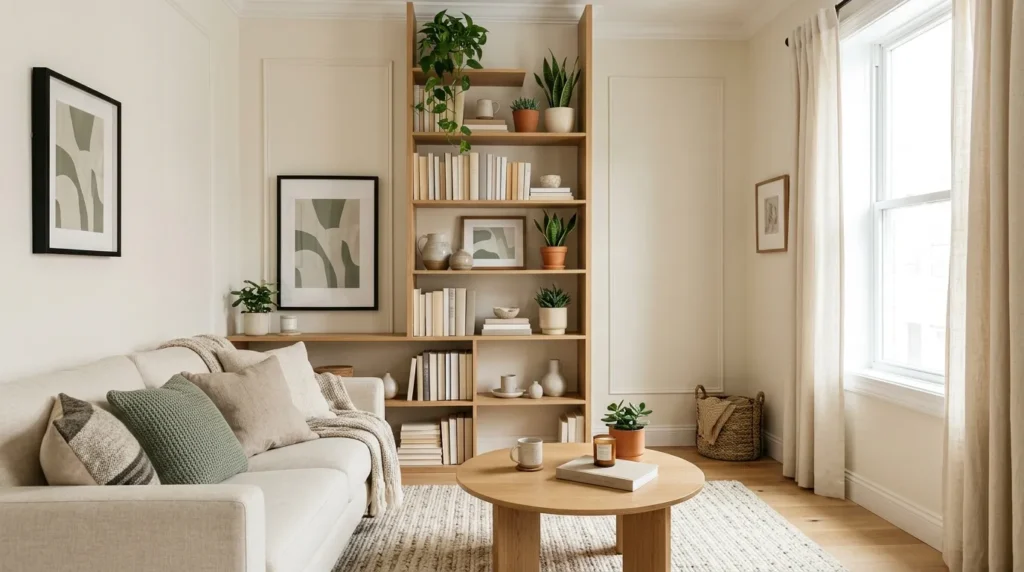
Quick Benefits
- Uses unused wall space
- Reduces floor clutter
- Adds decorative display space
- Works in rental-friendly layouts
- Makes ceilings feel taller
Why It Works
When floor space is limited, look upward.
The walls often provide valuable storage and display opportunities that aren’t being used.
Tall bookcases, narrow shelving units, wall-mounted shelves, and vertical cabinets can increase storage without expanding the furniture footprint.
This is particularly useful in apartments where you may need your living room to store books, electronics, games, decorative objects, or household essentials.
Vertical arrangements also draw the eye upward, which can make the room feel taller.
How To Style It
Choose shelving that is narrow enough to preserve walking space.
A tall bookcase can occupy one corner without dominating the entire room.
Mix books with baskets, framed art, ceramics, and small plants.
Don’t fill every shelf.
Leaving some empty space helps the arrangement feel lighter.
For rentals, consider appropriate removable or low-impact hanging solutions where permitted, and always follow the property’s rules.
5. Light Neutral Palette
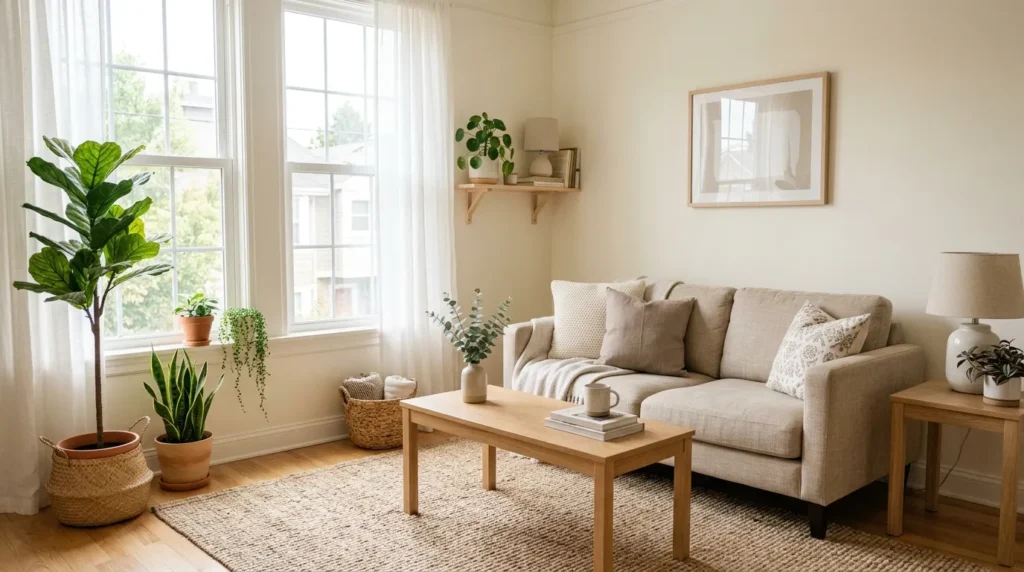
Quick Benefits
- Creates an airy appearance
- Makes furniture easier to coordinate
- Reflects natural light
- Creates a calm foundation
- Works across decorating styles
Why It Works
Color can strongly influence how a small room feels.
Light colors don’t physically increase the size of the room, but they can make the space appear brighter and more visually open.
Warm white, ivory, beige, pale taupe, soft gray, and muted earthy tones can create a comfortable apartment palette without making the room feel sterile.
The trick is adding enough contrast and texture to prevent the space from looking flat.
How To Style It
Begin with warm neutral walls if you’re able to paint.
Then layer cream upholstery, beige textiles, light wood, woven materials, and subtle patterns.
Introduce darker accents sparingly.
Black picture frames, charcoal lamps, or dark wood can provide definition.
Green plants are another easy way to add contrast without overwhelming the neutral palette.
If the apartment already has white walls, bring warmth through furniture and textiles instead of repainting.
6. Multifunctional Ottomans
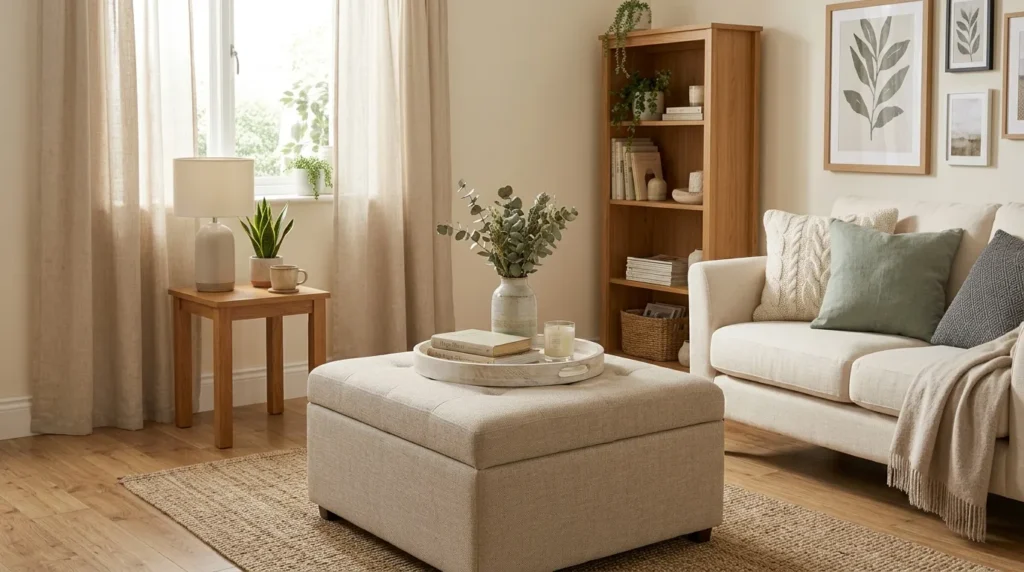
Quick Benefits
- Adds flexible seating
- Provides extra surface space
- Can hide storage
- Works as a footrest
- Reduces the need for multiple furniture pieces
Why It Works
Small rooms benefit enormously from furniture that serves more than one purpose.
An ottoman can function as a footrest, extra seating, coffee table, or storage container depending on the design.
That versatility is valuable when every square foot matters.
Instead of buying a coffee table and separate occasional seating, a large upholstered ottoman can sometimes handle both roles.
How To Style It
Choose an ottoman with a firm, reasonably flat top if you want to use it as a casual table.
Place a decorative tray on top to create a stable surface for drinks and accessories.
Storage ottomans are particularly useful for blankets, pillows, games, or seasonal items.
For a small room, consider a piece that can easily move when guests arrive.
Choose durable upholstery if the ottoman will receive frequent use.
7. Wall Mounted Lighting
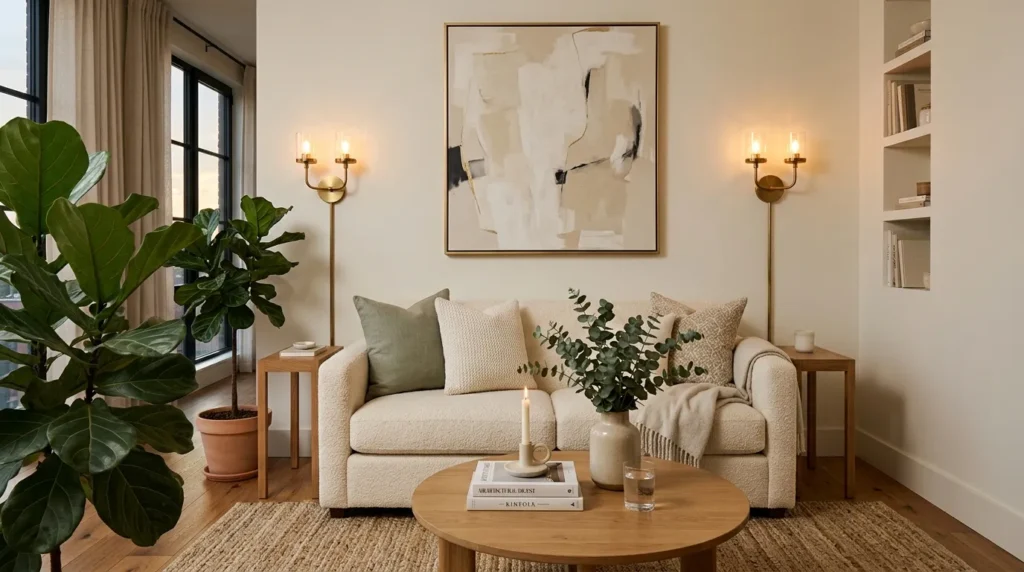
Quick Benefits
- Saves surface space
- Reduces floor clutter
- Adds visual interest
- Improves layered lighting
- Works well beside sofas
Why It Works
Traditional table lamps require side tables.
Floor lamps require floor space.
Wall-mounted lighting can provide the same functional illumination while keeping valuable surfaces and pathways clear.
This makes it particularly useful beside a sofa in a compact apartment.
Lighting also creates vertical interest, which can help a small living room feel more finished without adding bulky accessories.
How To Style It
Install sconces beside the sofa, reading chair, or artwork where appropriate.
Choose simple silhouettes for modern apartments.
Brass, black, ceramic, and natural wood finishes can all work depending on the decor.
If you’re renting, plug-in sconces can offer a more flexible alternative where permitted.
Use warm, comfortable lighting for evening ambiance and layer it with ceiling lighting and natural daylight.
8. Large Area Rugs
Quick Benefits
- Defines the seating area
- Connects furniture visually
- Adds warmth
- Introduces texture
- Helps open layouts feel intentional
Why It Works
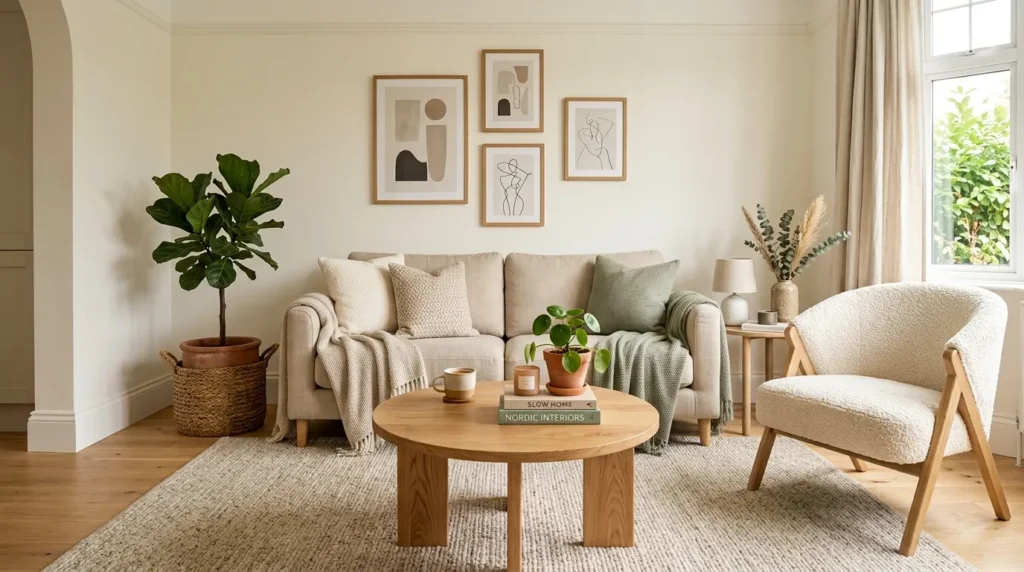
A rug can visually organize a small living room.
Without one, individual furniture pieces can appear disconnected.
With the right rug, the sofa, coffee table, and chairs can read as one cohesive seating area.
A common mistake is choosing a rug that is too small.
A tiny rug floating beneath the coffee table can make the furniture arrangement feel fragmented.
How To Style It
Choose a rug large enough for at least the front legs of the major seating pieces to sit on it when possible.
For a compact room, a low-pile rug can be practical and easier to maintain.
Neutral rugs with subtle patterns can add texture without overwhelming the space.
If you want something more dramatic, use the rug as the room’s main pattern and keep the rest of the decor relatively restrained.
9. Oversized Artwork
Quick Benefits
- Creates a focal point
- Reduces visual clutter
- Adds personality
- Makes walls feel intentional
- Can replace multiple small decorations
Why It Works
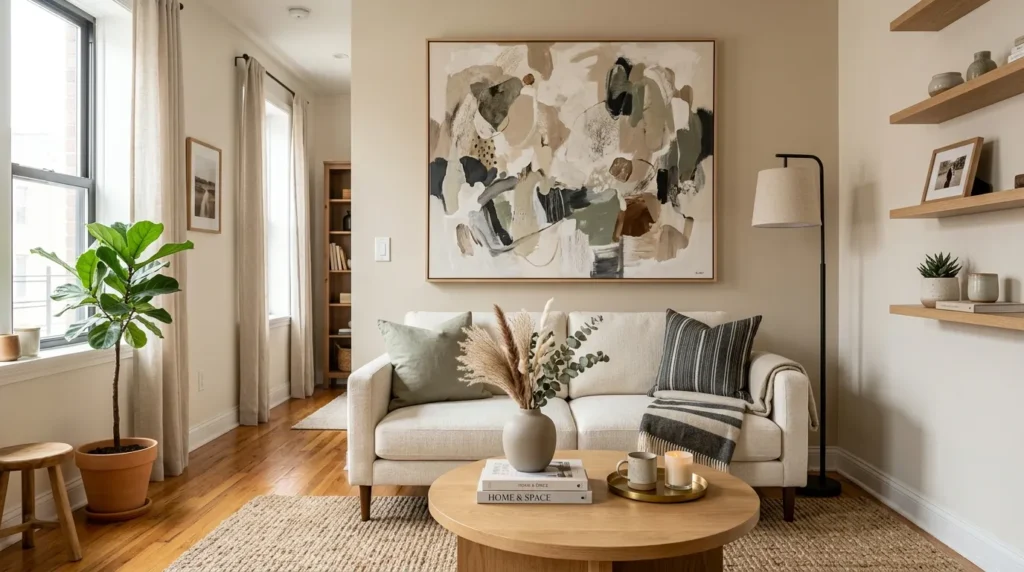
A small living room doesn’t necessarily need small artwork.
In fact, one large piece can sometimes look cleaner than a gallery wall containing numerous small frames.
A substantial artwork creates a single visual destination rather than several competing points of interest.
This can make the room feel more organized.
The artwork also provides an opportunity to introduce color without changing the furniture or walls.
How To Style It
Hang one large canvas above the sofa or position it on the most prominent wall.
Abstract artwork works beautifully in modern apartments.
Landscape paintings can create a softer, more traditional feeling.
For a neutral room, consider artwork featuring muted beige, olive, charcoal, cream, or warm brown.
Keep the surrounding wall relatively uncluttered so the piece has room to breathe.
10. Hidden Storage
Quick Benefits
- Reduces visible clutter
- Keeps small items organized
- Makes cleaning easier
- Supports minimalist decor
- Improves everyday functionality
Why It Works
A room can have beautiful furniture and still feel cramped when everyday items are left visible.
Remote controls, blankets, electronics, books, toys, paperwork, and miscellaneous objects quickly accumulate in a small living room.
Hidden storage gives these items a designated home.
The result isn’t simply a tidier room.
It creates visual calm.
How To Style It
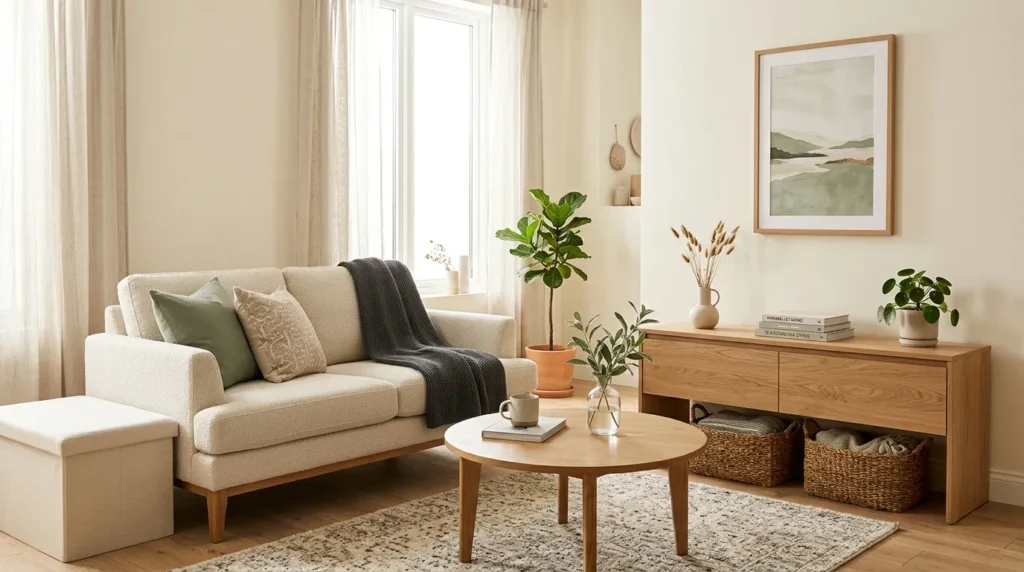
Choose furniture with built-in storage whenever possible.
A media console with closed cabinets can hide electronics and accessories.
Storage baskets can slide underneath open shelving.
A lift-top coffee table can provide concealed storage.
Use decorative boxes for smaller items.
The key is making storage convenient enough that you’re actually willing to use it every day.
If putting something away takes five steps, clutter tends to return.
How To Arrange Furniture In A Small Apartment Living Room
The best layout begins with circulation rather than decoration.
Before buying anything, measure the room.
Note doors, windows, vents, radiators, outlets, and other fixed features.
Then identify the primary activity.
Is the room mainly for television?
Reading?
Entertaining?
Working from home?
A combination?
Once you know that, choose the largest piece first.
Usually, that’s the sofa.
Then add the coffee table, secondary seating, storage, and lighting.
Leave clear walking routes between major areas.
Don’t force furniture into every empty corner simply because there’s room.
Negative space is part of good design.
How To Make An Apartment Living Room Look Bigger
There are several simple visual strategies that can help.
Use curtains mounted higher and wider than the window frame when appropriate.
Keep the floor visible around major furniture.
Choose furniture with raised legs when it suits the style.
Use mirrors strategically to reflect light and create depth.
Keep the color palette cohesive.
Avoid placing many small pieces throughout the room.
And make sure your furniture is appropriately scaled.
A small room doesn’t always need tiny furniture.
Too many small pieces can actually make the space feel busier.
One properly proportioned sofa and one well-chosen chair may work better than several miniature pieces.
Small Living Room Mistakes To Avoid
One of the most common mistakes is buying furniture before measuring.
Another is choosing a rug that’s too small.
People also tend to underestimate the importance of storage.
If there isn’t a designated place for everyday belongings, clutter becomes almost inevitable.
Too many decorative objects can create the same problem.
Instead of decorating every surface, choose a few pieces that have meaning or visual impact.
Finally, don’t be afraid of empty space.
A small living room doesn’t need to look full to feel complete.
FAQ
How can I make a small apartment living room feel bigger?
Use appropriately scaled furniture, keep pathways clear, choose a cohesive light-to-medium neutral palette, and avoid filling every surface with decor. Large artwork, strategically placed mirrors, vertical storage, and furniture with visible legs can also create a lighter visual effect.
What size sofa works best in a small living room?
The ideal sofa depends on the room’s dimensions, but compact three-seat sofas, apartment sofas, loveseats, and streamlined sectionals are often useful. Measure both the room and the sofa’s depth, width, and arm height before purchasing.
Should a small living room have a coffee table?
Not necessarily. A compact round table, nesting tables, C-table, or storage ottoman can provide similar functionality while taking up less visual and physical space.
What colors make a small living room feel larger?
Warm whites, cream, ivory, beige, pale taupe, and soft gray can help a room appear brighter and more open. The effect is strongest when the colors are combined with good natural or layered artificial lighting.
Is a large rug good for a small living room?
Yes. A properly sized rug can visually connect the seating area and make the layout feel more cohesive. A rug that is too small can make furniture appear disconnected and emphasize the limited size of the room.
How do I add storage without making my living room feel crowded?
Use vertical storage, closed media cabinets, storage ottomans, baskets, and multifunctional furniture. Prioritize pieces that provide storage without significantly increasing the room’s visual footprint.
How can renters decorate a small living room?
Focus on removable and flexible changes such as rugs, lighting, artwork, cushions, curtains, plants, furniture arrangement, and freestanding shelving. Always check your lease before painting or making wall modifications.
Conclusion
A small apartment living room doesn’t have to feel like a compromise.
The most functional spaces are usually created by making thoughtful decisions about proportion, circulation, storage, lighting, and visual balance.
Start with the furniture that matters most.
Choose a sofa that fits comfortably without overwhelming the room. Add a practical coffee table or multifunctional ottoman. Define the seating arrangement with a properly sized rug, then introduce vertical storage and layered lighting.
From there, focus on personality.
A large piece of artwork can create a memorable focal point. Warm neutral colors can make the room feel brighter. Natural wood and woven textures can add warmth. A few plants can bring life into the space.
Most importantly, don’t try to fill every corner.
A small living room benefits from breathing room just as much as a large one.
If you’re working with a rental, remember that you can create a dramatic difference without renovating. Rearranging furniture, adding a rug, upgrading lighting, and introducing smart storage can completely change how the room functions.
Start with the biggest problem your room has today.
If it’s clutter, solve storage first.
If it feels cramped, reconsider furniture proportions.
If it feels cold, add texture and warm lighting.
Build from there, one thoughtful change at a time, and your apartment living room can become a comfortable, stylish space that works beautifully for everyday life.
Related Articles
- 10 Modern Living Room Ideas with Cozy Neutral Furniture
- How to Decorate a Living Room with a Cozy Atmosphere
- 10 Modern Living Room Ideas with Designer Finishes
- 10 Small Balcony Ideas with Modern Outdoor Furniture
- 10 Bedroom Wall Decor Ideas with Oversized Art