
Can Standard Drywall Anchors Hold a 25-Pound School Backpack?
Determining whether you can safely hang a heavy bag on your wall often leads to questions about whether standard drywall anchors hold a 25-pound school backpack securely. Many homeowners assume that a plastic plug and screw combination offers enough strength for daily storage needs, but the physics of drywall often tell a different story.
If you are worried about your wall integrity or the risk of your gear crashing to the floor, understanding the specific limitations of common hardware is essential. This article explores the actual load-bearing capacity of these fasteners and explains why knowing the difference between a static load and a dynamic load is critical for your home setup.
The Direct Answer: Can Standard Drywall Anchors Hold a 25-Pound School Backpack?
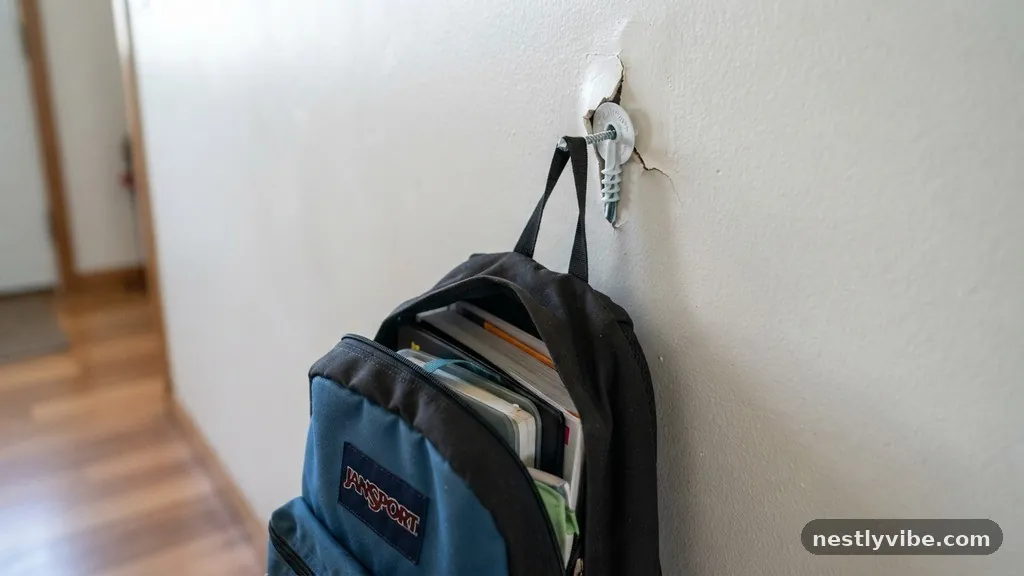
If you are looking for a simple answer, the reality is that most standard, entry-level plastic expansion anchors are not designed to reliably hold a 25-pound school backpack over the long term. While some manufacturers might claim a higher rating on the packaging, these figures often refer to static loads in ideal, laboratory-controlled conditions. A backpack is a dynamic object that you frequently pull off the wall, swing, and overload with extra books or gear.
The primary issue is the friable nature of gypsum board, which is the core material of your wall. When you pull on a backpack, you exert a downward force and a outward “lever” force that quickly creates a larger hole in the drywall.
Even if an anchor is rated for 25 pounds, it likely lacks the shear strength to handle the repetitive stress of a heavy bag. You should avoid using basic plastic sleeve anchors for anything weighing more than 10 to 15 pounds if the item will be handled or bumped regularly.
Understanding Drywall Anchor Weight Ratings
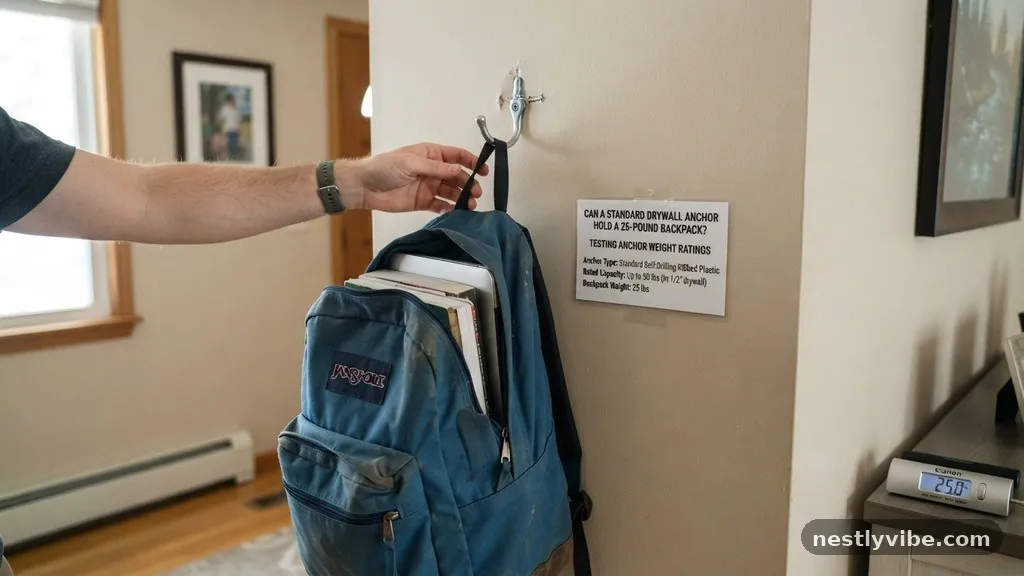
Most hardware stores sell basic anchors that come in plastic blister packs, often labeled with a “rated weight” on the back. These ratings are almost always calculated as a static pull-out force, meaning the weight is applied slowly and gently without any vibration or movement.
Real-world scenarios are never this gentle. When you hang a 25-pound pack, you are likely dropping it onto the hook or pulling it off with a sharp tug.
This action creates a shock load that can be several times the actual weight of the object. Drywall, being a soft, chalky material, cannot withstand these localized pressure spikes for very long.
Over time, the anchor will begin to wiggle, enlarging the hole in the drywall until the entire fastener eventually pops out. Relying on the maximum weight listed on the package is a common mistake that leads to damaged walls and broken belongings.
The Difference Between Shear and Tensile Load
To understand if a fastener will hold, you must distinguish between how the weight is applied to the wall. Tensile load is a direct pull, like pulling a plug straight out of a socket, while shear load is the downward force created by gravity acting on a hook. Drywall anchors are notoriously poor at handling high shear loads because the drywall material itself is prone to crumbling under that downward pressure.
A backpack hanging on a hook creates a significant shear force that wants to tear the anchor downward through the wall surface. Because the drywall is only about half an inch thick, the anchor has very little material to “bite” into.
As the hook pulls down, it creates a vertical slot in the hole, causing the anchor to lose its grip. This is why heavy items should almost always be secured into a wooden stud rather than relying on an anchor in the open wall.
Why Studs Are Always the Better Option
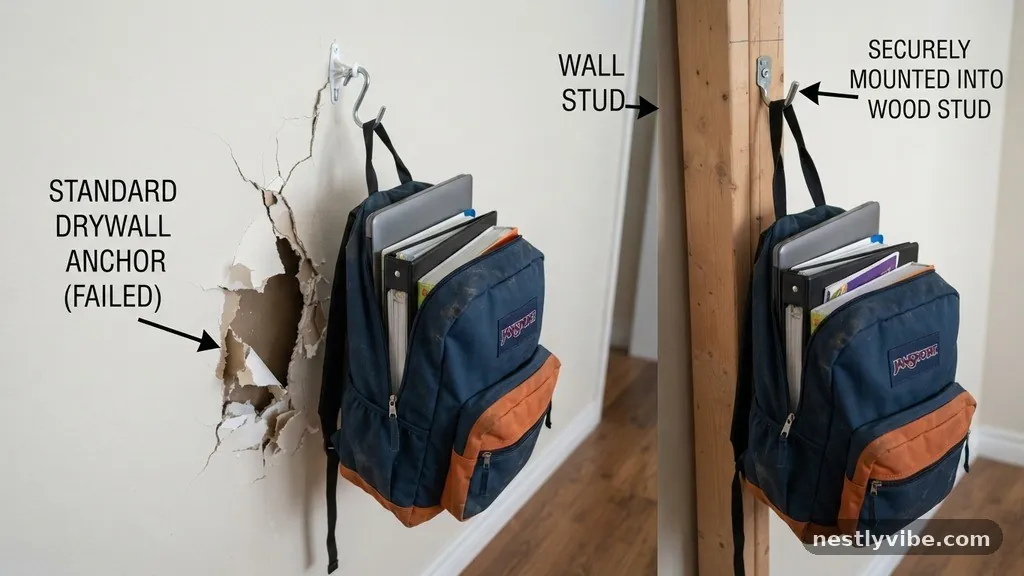
Whenever possible, you should locate the wooden studs behind your drywall to mount heavy items. A screw driven directly into a stud provides a mechanical connection to the structural frame of your home, which is designed to carry weight. A stud can easily support a 25-pound backpack, or even a 100-pound mirror, because the wood is dense and fibrous.
You can locate studs using a simple electronic stud finder or by looking for signs like trim nails or electrical outlets. Electrical boxes are almost always attached to the side of a stud, which gives you a reliable reference point.
If you cannot align your hook with a stud, you must move beyond standard light-duty plastic anchors. Using specialized hardware is the only way to safely support heavy items in hollow drywall.
Types of Fasteners and Their True Capacity
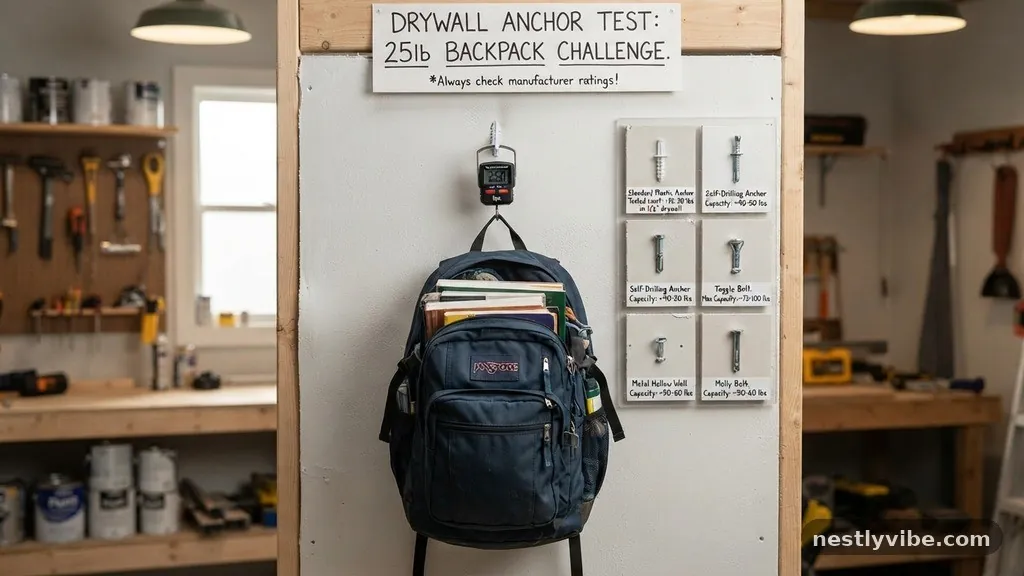
Not all wall fasteners are created equal, and the type you choose determines whether your project succeeds or fails. Standard plastic expansion anchors are the weakest, relying on the friction of the plastic against the drywall. Toggle bolts, on the other hand, use a metal wing that spreads out behind the wall, distributing the load over a much larger surface area.
Comparison of Common Wall Fasteners
| Fastener Type | Load Capacity (Approx.) | Best Use Case |
|---|---|---|
| Plastic Expansion Anchor | 5–10 lbs | Light pictures, small decor |
| Threaded Drywall Anchor | 10–15 lbs | Medium frames, lightweight items |
| Toggle Bolt | 30–50 lbs | Heavy mirrors, shelves, heavy bags |
| Stud-Mounted Screw | 100+ lbs | Heavy shelving, large cabinets |
As shown in the table, the jump in capacity between a standard plastic anchor and a toggle bolt is significant. If you absolutely must hang a heavy backpack on a section of wall without a stud, a toggle bolt is the only reliable choice. It captures the drywall between the front flange and the metal toggle, preventing the fastener from pulling through the wall.
Common Installation Mistakes to Avoid
Even if you buy heavy-duty hardware, poor installation can lead to failure. One of the most common errors is drilling a hole that is too large for the anchor.
The anchor should fit snugly into the wall; if you have to wiggle the drill to get it in, the hole is already too big. A loose fit means the anchor has zero support against the drywall, ensuring it will fail under any significant weight.
Another mistake is failing to account for the thickness of the drywall. Standard drywall is 1/2 inch thick, but some older homes have thicker lath and plaster, while newer ones might use 5/8 inch fire-rated board.
Using an anchor that is too short will prevent it from expanding properly behind the wall. Always check the manufacturer’s recommendations for the specific wall thickness of your home.
Signs Your Wall Anchor is Failing
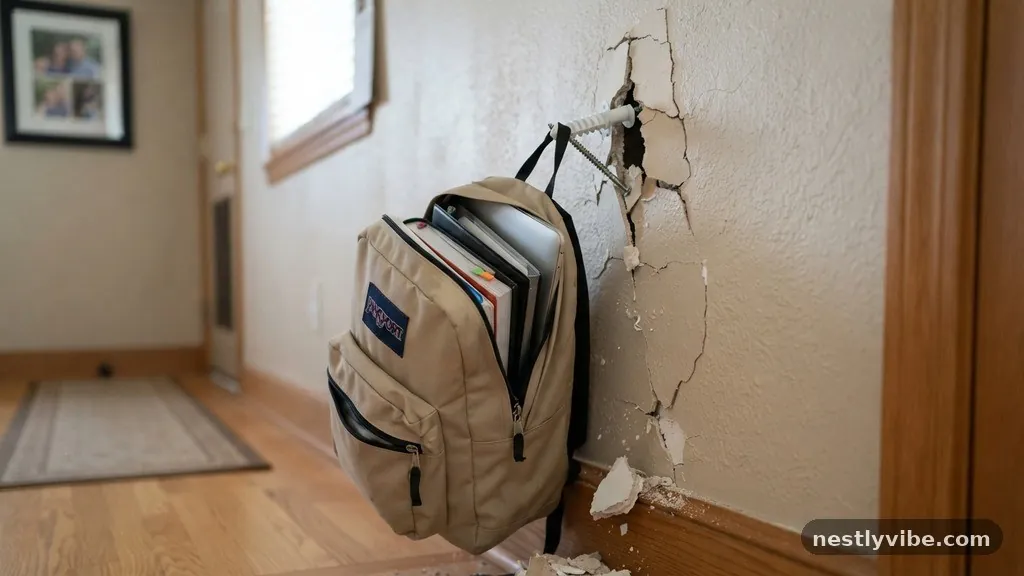
If you have already hung your backpack, you should keep an eye on the wall for signs of distress. The most obvious sign is a visible crack appearing in the paint or drywall around the anchor flange. This indicates that the weight is pulling the anchor downward and crushing the gypsum core.
Another warning sign is if the hook feels loose or “spongy” when you pull on it. If you can wiggle the bracket with your fingers, it is only a matter of time before it pulls out entirely.
Do not ignore these signs, as a sudden failure can punch a large, unsightly hole in your wall that is much harder to repair than a small screw hole. You can find more information on wall maintenance and repair through the National Park Service technical preservation guidance regarding wall materials.
How to Repair Drywall After an Anchor Pulls Out
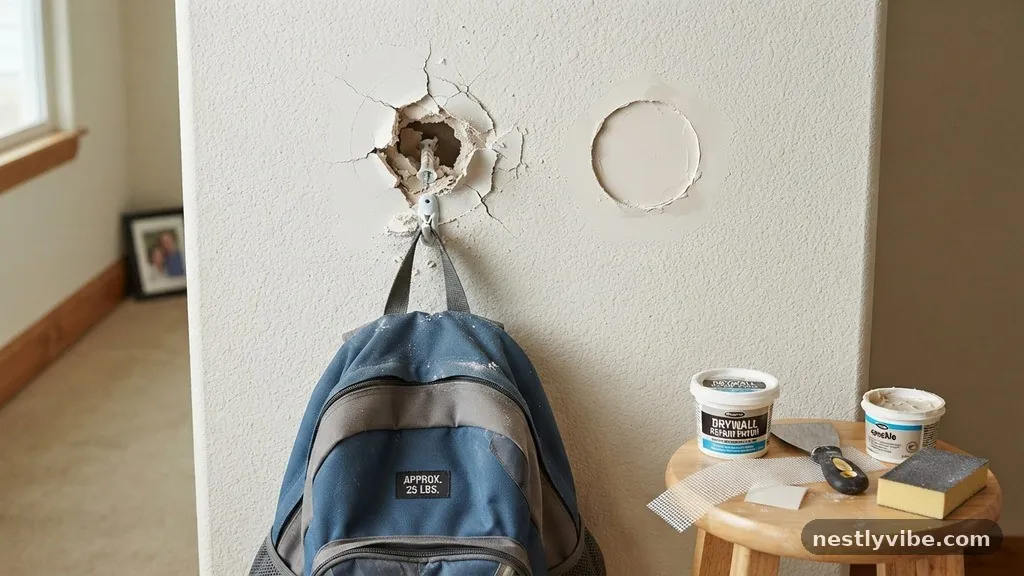
If you have already had an anchor pull out, you will likely be left with a jagged, oversized hole. Do not try to put a new anchor in the same spot, as the drywall has already been compromised. You will need to patch the hole with spackle or a wall repair kit before you can attempt to hang anything new.
For larger holes, you may need a mesh patch or a “California patch” to provide a stable base for the filler. Once the patch is dry, sand it smooth and apply a fresh coat of paint to match the wall. If you still need to hang your backpack in that general area, shift your target to a nearby stud or use a toggle bolt if you must stay on the open drywall.
Alternative Storage Solutions for Heavy Bags
If you are struggling to find a safe way to hang a heavy backpack, consider whether a wall hook is actually the best solution. Many people find that a dedicated coat rack or a standing storage unit is a much more effective way to manage heavy items. These units transfer the weight to the floor, completely removing the risk of damaging your wall or causing a failure.
If floor space is limited, you might consider an over-the-door hook system. These units hang over the top of a door and are supported by the door frame, which is significantly stronger than drywall. This allows you to store heavy bags, jackets, and other gear without ever needing to drill into your walls or worry about weight limits.
FAQ: Frequently Asked Questions
Can I use two anchors to double the weight capacity?
Using two anchors to hold a single heavy item is often ineffective because the weight is rarely distributed perfectly between them. If one anchor shifts even slightly, the entire load can transfer to the other, leading to a cascading failure. It is always better to use one high-quality fastener secured into a stud than two weak ones in the drywall.
Do toggle bolts work on all types of walls?
Toggle bolts are excellent for hollow drywall, but they are not suitable for solid masonry or concrete walls. They require a hollow space behind the surface to open the metal wings. If you are mounting items into brick or concrete, you will need masonry anchors or concrete screws like tapcons instead.
Is there a way to make a plastic anchor stronger?
There is no reliable way to reinforce a standard plastic expansion anchor once it is in the wall. Some people suggest adding glue or wood filler to the hole, but these materials are not designed to bond with drywall in a way that provides structural support. If an anchor feels weak, the only safe solution is to remove it and use a more appropriate fastener.
How do I know if I have hit a stud?
When you are drilling, you will feel a distinct change in resistance as the bit moves from the soft, powdery drywall into the solid wood of the stud. If you are using a drill, the motor will work harder, and you will see wood shavings on the drill bit rather than white gypsum dust. If the drill bit goes through the wall with very little resistance, you are likely in a hollow section.
What is the absolute maximum a standard plastic anchor can hold?
While some packaging might claim up to 20 or 25 pounds, these are best-case scenarios for static, non-moving items. For a 25-pound school backpack that is handled daily, you should never trust a plastic anchor. Even if it holds for a week or a month, the fatigue will eventually lead to a failure that could damage your wall.
Conclusion
Determining whether you can safely use standard drywall anchors for a 25-pound school backpack usually leads to the conclusion that you should avoid them. While these fasteners are convenient for lightweight decor, the dynamic nature of a heavy bag will almost certainly compromise the integrity of the drywall over time. Prioritizing stud-mounted hardware or using high-strength toggle bolts will save you from the headache of repairing large wall holes later.
By understanding the difference between static and shear loads, you can make informed decisions that keep your belongings secure and your walls in pristine condition. If you have been struggling with failing hooks, take a moment to evaluate your current setup and switch to a more reliable storage method today.